
2025 VCE Results: ATAR trends, the top schools of 2025 and what to make of it all
The 2025 VCE results have now been released, marking a major milestone for tens of thousands of Victorian students. At 7am on Thursday, 11 December, students across the state logged in to view their study scores and ATARs, results that will shape university offers, tertiary pathways and planning for 2026 and beyond.
Beyond individual outcomes, the 2025 data provides valuable insight into statewide performance trends, school outcomes, and how high achievement is actually distributed across Victoria. For parents, students and educators alike, understanding how these numbers are generated – and what they really mean – is really important.
Keep reading to learn:
- the key statistics from the 2025 VCE cohort
- how study scores and ATARs are calculated
- which schools performed strongly and why
- what school rankings do not tell you
- and how students should use these results strategically heading into 2026
2025 VCE Results snapshot: key statistics
The 2025 VCE cohort was large, competitive and academically strong.
Key figures from this year include:
- 65,586 students completed the VCE, representing a 97.3% completion rate
- 42 students achieved a perfect 99.95 ATAR
- 664 students achieved one or more perfect 50 study scores
- A total of 719 perfect study scores were awarded
- 23,494 study scores of 40 or above, accounting for 25% of all study scores statewide
- The average ATAR in 2025 was 69.48, virtually unchanged from 2024
These results confirm that the VCE remains a statewide ranking system, not a school-based grading exercise.
Trends in the 2025 ATAR Results
The 2025 data again revealed differences in average ATAR performance:
- Girls: 70.20
- Boys: 68.60
- Gender diverse students: 72.40
There was also a shift in the gender distribution of perfect ATAR recipients compared with 2024, with a higher proportion of female students achieving 99.95 in 2025. While outcomes are influenced by many factors, this trend has been consistent across recent years.

What Is a Study Score?
A study score is a subject-specific ranking that shows how a student performed relative to all other Victorian students taking the same subject. It is reported on a scale from 0 to 50, where 50 is the maximum possible score that can be achieved.
However, arriving at that final number involves two distinct processes, which are often incorrectly collapsed into one. Understanding these processes is critical to interpreting VCE results correctly.
Step 1:
The VCAA converts your raw marks to moderated but still raw Study Score:
Throughout the year, students accumulate raw marks from:
- School-Assessed Coursework (SACs)
- School-Assessed Tasks (SATs), where relevant
- the end-of-year external examination
These raw marks cannot be used directly, because SACs differ in difficulty and marking standards between schools.
To correct for this, the VCAA applies statistical moderation:
- students are ranked within their school based on SAC performance
- each school’s SAC distribution is aligned to its students’ exam performance
- SAC scores are adjusted so that they reflect the same standard as the external exam
Once this process is complete, each student receives what is best described as a moderated and raw study score.
At this point:
- students are ranked fairly within the subject
- school-to-school marking differences have been corrected
- the score reflects performance only against students doing the same subject
This moderated study score is still subject-specific and has not yet been adjusted to compare different subjects.

Step 2: Study Score Scaling for ATAR Equivalence
The second stage occurs after moderated study scores are produced.
Different VCE subjects vary in:
- cohort strength
- competitiveness
- score distributions
To ensure fairness when combining subjects into an ATAR, VTAC applies scaling to study scores.
This scaling:
- adjusts study scores up or down
- ensures students of similar academic strength are treated equivalently across subjects
- allows study scores from different subjects to be meaningfully combined
This is the scaling most people are referring to when they say:
“Some subjects scale up, others scale down.”
Importantly:
- this scaling does not change a student’s rank within a subject
- it only affects how that subject contributes to the ATAR
As a statewide ranking within a subject:
- a 40+ study score places a student in approximately the top 9%
- a 45+ study score places a student in roughly the top 2%
- a 50 study score places a student in the top ~0.1% statewide
Because moderation occurs before scaling, and scaling occurs after, two students from different schools with the same study score have achieved equivalent performance in that subject, regardless of where they studied.
Most confusion around VCE results comes from mixing up:
- moderation (which corrects for school differences), and
- scaling (which equalises subjects for ATAR purposes)
They serve different functions, occur at different stages, and solve different fairness problems.
Understanding this explains:
- why difficult SACs do not “doom” students
- why strong exam performance matters
- why subject choice affects ATAR contribution without affecting subject rank
This two-stage process is what allows the VCE to operate as a statewide ranking system, rather than a school-by-school competition.

How schools performed in 2025
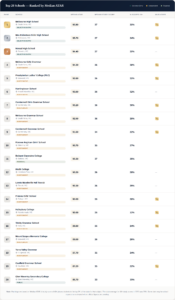
When comparing schools, the most meaningful indicators of performance are:
- Median ATAR
- Median study score
- Percentage of study scores above 40
Together, these metrics reflect cohort strength and depth, not guaranteed outcomes for individual students.
A high-performing school typically shows consistency across the cohort, rather than reliance on a small number of top scorers.
Perfect ATARs in 2025:
Achieving a 99.95 ATAR is extraordinarily rare. In 2025, only 42 students statewide reached this level.
While some schools produced multiple perfect ATAR recipients, an important takeaway remains:
Perfect ATARs are achieved across selective, independent and non-selective schools.
This reinforces a core truth of the VCE:
Individual preparation and internal rank matter far more than school branding alone.
ATAR 90+ and 99+ Results:
Looking beyond perfect scores, the proportion of students achieving ATARs above 90 or 99 provides a more reliable indicator of school performance.
In 2025:
- several schools recorded 50% or more of students achieving ATAR 90+
- multiple schools achieved double-digit percentages of ATARs above 99
These results reflect academic depth across cohorts, not just isolated elite outcomes.
What the 2025 VCE results do not tell you
Published rankings do not show:
- how selective a school’s intake is
- how many high-achieving students chose IB instead of VCE
- how wide the distribution of results is within a cohort
- how an individual student ranked internally
For parents, this distinction is critical:
a high median ATAR reflects a strong cohort, not a guaranteed outcome for every student.
IB Pathways and why some school results appear lower
Many high-performing schools offer both VCE and the International Baccalaureate (IB).
In these schools:
- a significant proportion of top academic students opt for IB
- VCE-only results may understate the school’s total academic strength
IB results are converted to ATAR equivalents later, meaning early VCE rankings do not always reflect the full academic picture.
How Students Should Use the 2025 Results Strategically
The real value of the 2025 VCE data lies in strategy, not comparison.
- Treat school rankings as benchmarks.
Your rank within your cohort ultimately determines outcomes. - Target 40+ study scores.
With 25% of all study scores at 40+, this remains the most reliable ATAR-building threshold. - Identify subject gaps early.
The holiday period is the best time to strengthen weaker subjects. - Personalised feedback creates separation.
At the top end, marginal gains in exam technique and structure make the biggest difference.

Frequently Asked Questions (FAQs) about the 2025 VCE Results
When were the 2025 VCE results released?
- Thursday, 11 December 2025 at 7am.
How many students achieved a perfect ATAR in 2025?
- 42 students achieved a 99.95 ATAR.
What was the average ATAR in 2025?
- 69.48.
What is considered a good ATAR?
- ATAR 70+ is above average; 90+ is highly competitive, depending on course requirements.
When are university offers released?
- Through VTAC offer rounds following ATAR release.
Ultimately:
The 2025 VCE results demonstrate strong statewide achievement, with tens of thousands of students performing at a high level across a wide range of schools.
While rankings and perfect scores attract attention, the deeper lesson remains consistent year after year:
Individual preparation, subject mastery and strategic support matter far more than school reputation alone.
For students planning their 2026 pathway, understanding how these results are generated – and how to respond strategically – is the real advantage.